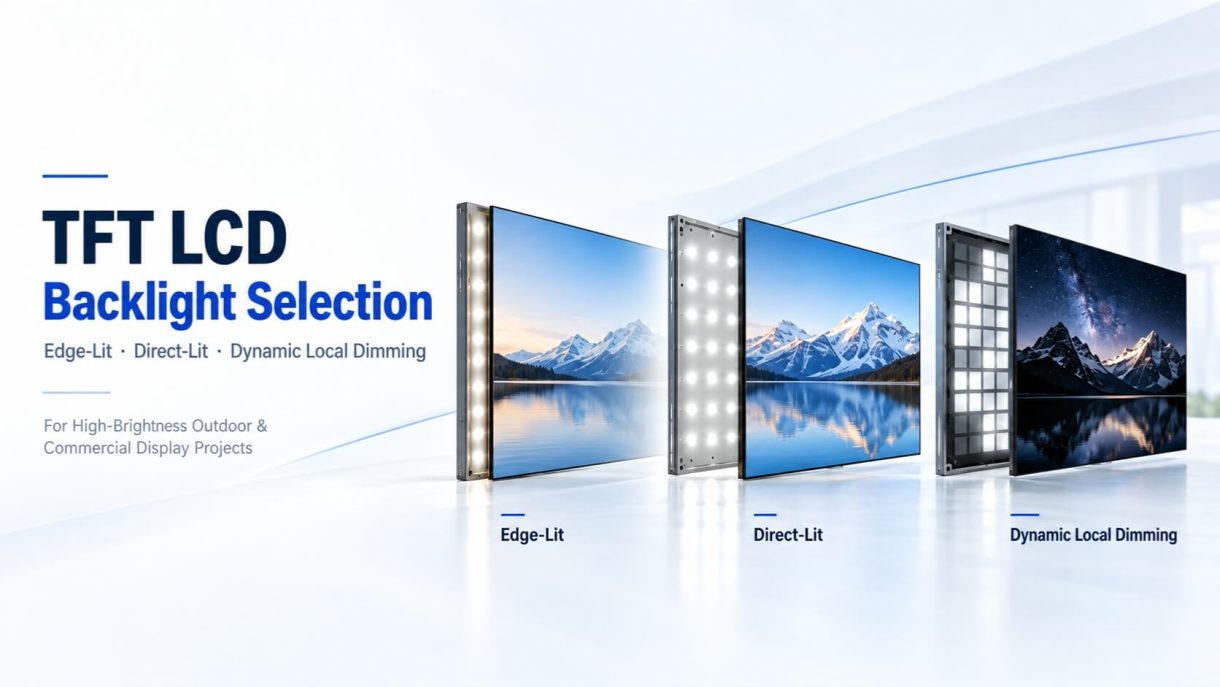
Comparing brightness, display size, module depth and backlight control for outdoor and commercial display projects.
Backlight selection becomes increasingly important when TFT LCD is used in outdoor, transportation, industrial or commercial display equipment.
For most projects, backlight decision is not simply about choosing Edge-Lit or Direct-Lit. Engineering and purchasing teams also need to consider required brightness, display size, installation depth, power consumption, thermal conditions, contrast requirement and backlight control.
MAXEN currently provides outdoor TFT display configurations covering Edge-Lit Static Backlight, Direct-Lit Static Backlight and Dynamic Local Dimming Backlight, with brightness ranging from 1000 to 3000 nits plus higher local peak brightness for selected dynamic backlight models.

Edge-Lit backlight is suitable for projects where display thickness and mechanical integration are important. LED light sources are positioned along display edge, supporting relatively slim backlight structure compared with many Direct-Lit designs.
Typical applications include digital signage, commercial information displays, self-service terminals, wall-mounted displays and semi-outdoor equipment.
For projects requiring high brightness while maintaining relatively slim mechanical structure, Edge-Lit provides practical balance between luminance and installation depth.
When project requires higher display brightness, Direct-Lit backlight provides more flexibility for high-output display design. LED light sources are distributed behind LCD area rather than only along display edge.
Typical applications include outdoor advertising displays, outdoor kiosks, transportation information systems, large commercial displays and industrial equipment exposed to strong ambient light.
Higher brightness also increases requirements for power supply, heat dissipation, enclosure design and long-term brightness stability. Target brightness should therefore match actual installation environment rather than simply selecting highest available value.
Some projects require more than high display brightness. Applications showing both bright and dark content may also require higher dynamic contrast, stronger dark-area performance, higher local peak brightness and more precise backlight control.
For these requirements, Dynamic Backlight with Local Dimming provides another option.
Unlike Static Backlight, Dynamic Backlight adjusts different backlight zones according to image content. Bright areas can maintain higher output while darker areas reduce unnecessary backlight intensity.

Dynamic Local Dimming is more relevant for premium outdoor digital signage, transportation display systems and commercial displays where brightness alone is not enough and image contrast also becomes important.

| Specification | Edge-Lit Static | Direct-Lit Static | Dynamic Local Dimming |
|---|---|---|---|
| Size Range | 21.5"–43" | 32"–86" | 32"–75" |
| Resolution | FHD / 4K | FHD / 4K | FHD / 4K |
| Brightness | 1000–1500 nits | 2000–3000 nits | 2000–3000 nits |
| Local Peak Brightness | — | — | Up to 4000 nits |
| Color Gamut | 72% NTSC | 72% NTSC | 95% NTSC |
| Backlight Control | Static | Static | Dynamic |
| Local Dimming | No | No | 1152 zones |
| Dynamic Contrast | Panel dependent | Panel dependent | Up to 1,000,000:1 |
| Mechanical Focus | Slim structure | High brightness | Brightness + zone control |
| Typical Project | Semi-outdoor / commercial | Outdoor / ultra-high brightness | Premium outdoor / high contrast |
Suitable when project requires 1000–1500 nits, relatively slim structure and commercial or semi-outdoor installation.
Suitable when project requires 2000–3000 nits, larger display size and stronger outdoor readability without local dimming.
Suitable when project requires high brightness together with local dimming, higher dynamic contrast and higher local peak brightness.
Brightness specification should not be evaluated independently. Outdoor and high-brightness TFT LCD projects should also consider:
For example, 3000-nit Static Backlight and 3000-nit Dynamic Backlight may have similar rated brightness but serve different project requirements. Static Backlight focuses mainly on high luminance, while Dynamic Backlight adds multi-zone brightness control, higher dynamic contrast and higher local peak brightness.
Mini-LED and Direct-Lit are not same concept.
Edge-Lit and Direct-Lit describe backlight structure, while Mini-LED describes backlight light-source technology.
Mini-LED is commonly combined with Direct-Lit structure and multi-zone local dimming. However, Direct-Lit backlight does not automatically mean Mini-LED, since conventional LED can also be used in Direct-Lit Static Backlight.
For project evaluation, it is more useful to confirm backlight structure, control method, local dimming zones, rated brightness and local peak brightness rather than relying on Mini-LED terminology alone.
MAXEN supports flexible LED backlight configurations for different TFT LCD project requirements, including Edge-Lit Static Backlight, Direct-Lit Static Backlight and Dynamic Local Dimming.
Backlight selection can be evaluated according to display size, target brightness, mechanical structure, installation environment and backlight control requirements.
For slim commercial and semi-outdoor display projects.
For large-size outdoor and ultra-high-brightness display projects.
For projects requiring high brightness, stronger dynamic contrast and local dimming control.
For projects requiring additional display changes, brightness, interface and mechanical specifications can also be evaluated through MAXEN custom TFT LCD display development.
Edge-Lit is commonly selected when slimmer structure and 1000–1500-nit brightness are required. Current MAXEN Direct-Lit configurations focus on larger displays and 2000–3000-nit high-brightness applications.
Not automatically. Final brightness depends on LED output, optical efficiency, drive conditions and LCD configuration. Within current MAXEN product range, Direct-Lit models are positioned for 2000–3000-nit requirements.
No. Direct-Lit describes LED position, while Mini-LED describes backlight light-source technology. Conventional LED can also use Direct-Lit structure.
Selection depends on ambient light, display size, enclosure depth and target brightness. Edge-Lit can support many 1000–1500-nit projects, while Direct-Lit is available for 2000–3000-nit high-brightness applications.
Dynamic Local Dimming is more suitable when project requires high brightness together with higher dynamic contrast, local peak brightness and more precise control between bright and dark image areas.
High-brightness display projects require different balance between brightness, display size, installation depth, power and backlight control.
Send MAXEN your display size, resolution, target brightness, installation environment and application requirements. Our team can evaluate suitable Edge-Lit, Direct-Lit or Dynamic Local Dimming configuration for your project.
Discuss Your Display Project




+86-13923461826