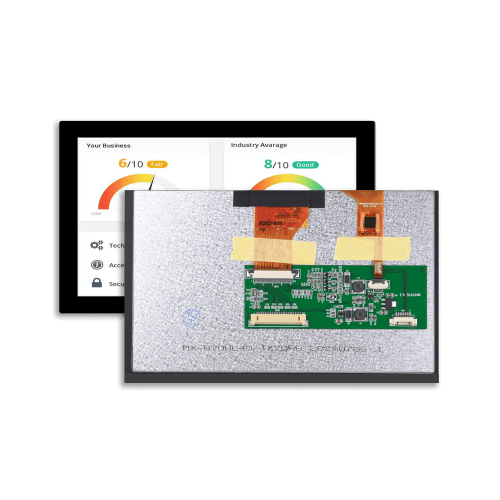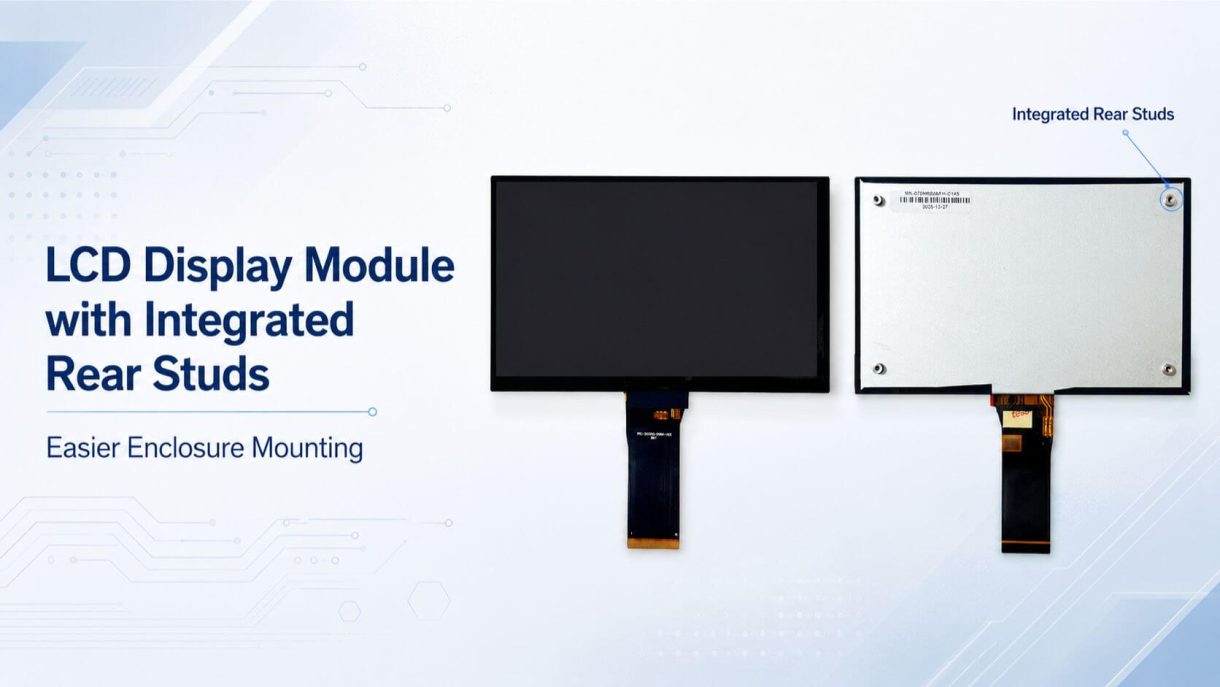
"Good design is thorough down to the last detail." This idea is especially true when an LCD display module needs to be integrated into a compact enclosure.
In industrial equipment design, project teams often focus first on display size, brightness, interface, touch function, and operating temperature. However, one small mechanical detail can strongly affect the final assembly process: how the display is mounted inside the enclosure.
A standard LCD display module may look suitable on the datasheet, but during production, loose screws, washers, nuts, or extra brackets can quickly become a challenge. They add parts, slow down installation, and may even create reliability risks if small hardware drops inside the device.
This is why MAXEN offers LCD display modules with integrated rear studs. By adding defined mounting points on the rear side of the module, the display can be installed more easily, with fewer loose parts and more consistent positioning.
Traditional frame mounting usually requires operators to align the display module with housing tabs while also handling loose screws, washers, and nuts. In a compact enclosure, this can be slow and difficult. It may also increase the risk of cross-threading, axis misalignment, or small parts falling into the device.
An integrated rear stud design changes the mounting method. The threaded fixing points are already built into the rear side of the LCD module, so the operator can position the display and fasten it from the enclosure side more directly.
| Item | Conventional Frame Mounting | Integrated Rear Studs |
| Fastener parts | Separate screws, washers, nuts, brackets | Rear studs integrated on the module |
| Assembly operation | Dual-side tightening may be required | Easier single-side fastening |
| Alignment control | Depends more on operator handling | Stud position is defined on the module |
| Risk of loose parts | Higher risk of dropped nuts or washers | Fewer loose hardware components |
| Serviceability | More parts to remove during maintenance | Faster access and reassembly |
| Best suited for | Simple or low-volume structures | Industrial and compact enclosure designs |
For industrial TFT display screen projects, reducing loose hardware can help simplify assembly and improve consistency from sample build to mass production.
Rear studs are small, but their impact on assembly can be significant. By moving the fixing points directly onto the back side of the LCD display module, they help turn a multi-part mounting process into a cleaner and more predictable installation step.
Integrated rear studs provide clear fixing points on the back side of the LCD display module. This helps operators align the module more quickly during assembly and reduces the need to handle multiple small parts at the same time.
For production teams, this can reduce assembly complexity. For project teams, it can shorten the time required to evaluate enclosure fit and mounting feasibility.
When mounting points are built into the module structure, the TFT display can be positioned more consistently inside the enclosure. This is useful for projects where the visible display area, cover glass opening, housing frame, and touch area must align accurately.
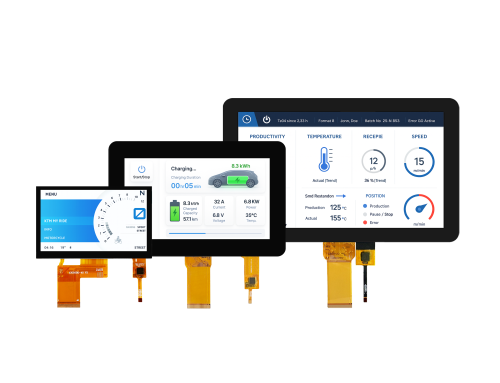
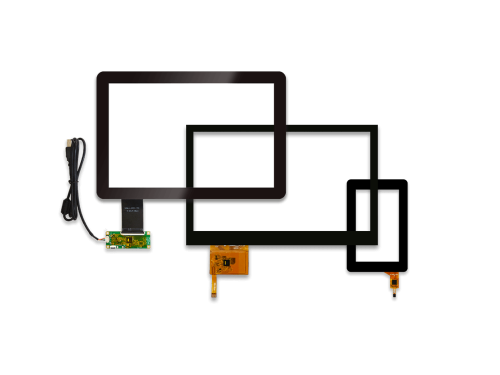
For a touch display or touch screen LCD display, mechanical alignment is especially important because the LCD, PCAP touch panel, cover glass, and housing opening must work together.
Loose screws, washers, and nuts may create risk during production, repair, or field service. In products with PCBs, batteries, cables, or high-density internal layouts, dropped metal parts can become a serious reliability concern.
Integrated rear studs help reduce this risk by minimizing loose fastening components on the display side.
Modern industrial and smart devices often require thinner housings and tighter internal layouts. Traditional mounting methods may require space for nuts, screw heads, brackets, or washers.
Rear studs can help simplify the internal mounting structure and leave more room for PCBs, thermal pads, speakers, connectors, cables, batteries, or touch controller components.
An integrated rear stud structure must be designed together with the LCD module's metal back frame. It is not only a fastening feature; it is part of the mechanical structure of the display module.
For industrial LCD modules, the rear frame may use metal materials such as SECC steel, stainless steel, or other project-specific sheet metal structures. During stud installation, engineers should carefully control pressure, alignment, and support tooling to keep the rear frame strong and prevent deformation.
Key quality points include:
For high-reliability projects, MAXEN can review the customer's housing drawing, mounting direction, screw specification, target torque, and application environment before sampling. This helps reduce the risk of enclosure mismatch or late-stage mechanical changes.
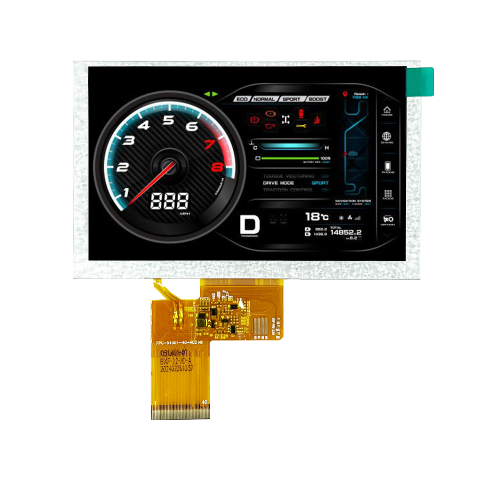
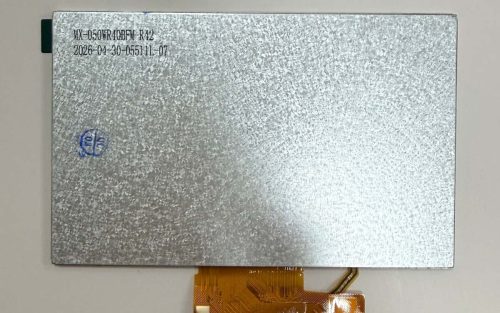
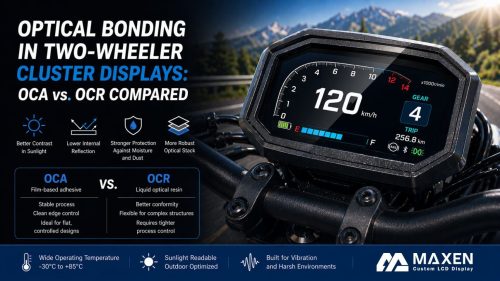
MAXEN's 7 Inch IPS LCD Touch Screen is a practical LCD display module example designed for two-wheeler dashboard applications. It combines high brightness, wide temperature support, PCAP touch, cover glass, OCR optical bonding, and integrated rear studs for easier enclosure mounting.
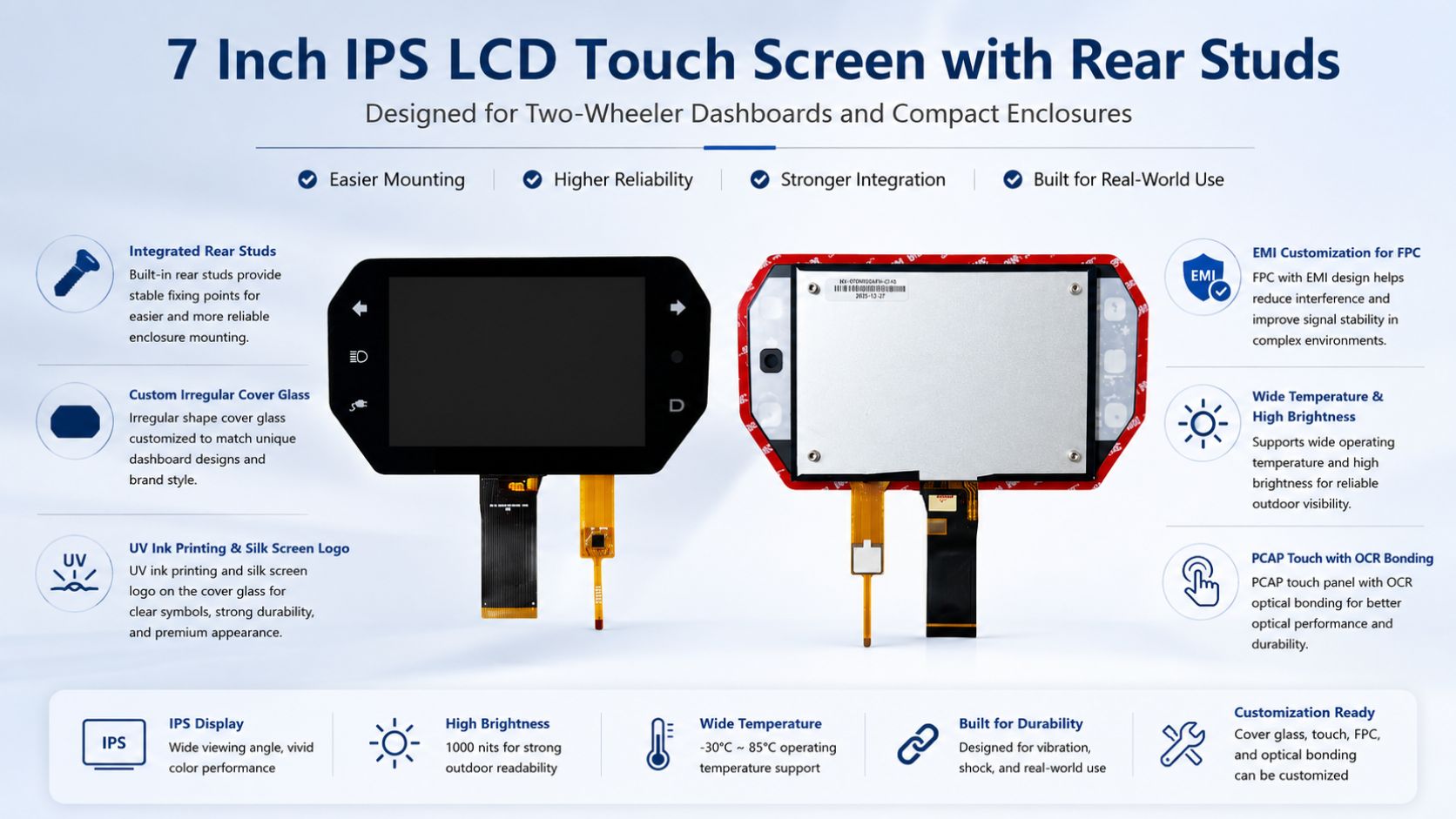
The rear studs provide fixed mounting points on the back side of the module, helping reduce loose nuts, extra brackets, and complex fixing structures. This makes the display easier to install into compact housings used in dashboards, outdoor terminals, EV charging equipment, and industrial control panels.
For projects that require different brightness, interface, touch, size, or temperature requirements, MAXEN also support:
For more dashboard and instrument panel solutions, visit our Cluster Display LCD category.
This product can be used as a reference solution for project teams looking for a TFT display screen or touch screen LCD display with easier mounting and better enclosure integration.
In addition to integrated rear studs on the LCD metal frame, MAXEN can also support a bonded rear plate with studs. This structure is useful when the project needs rear-side mounting points while keeping a clean front appearance.
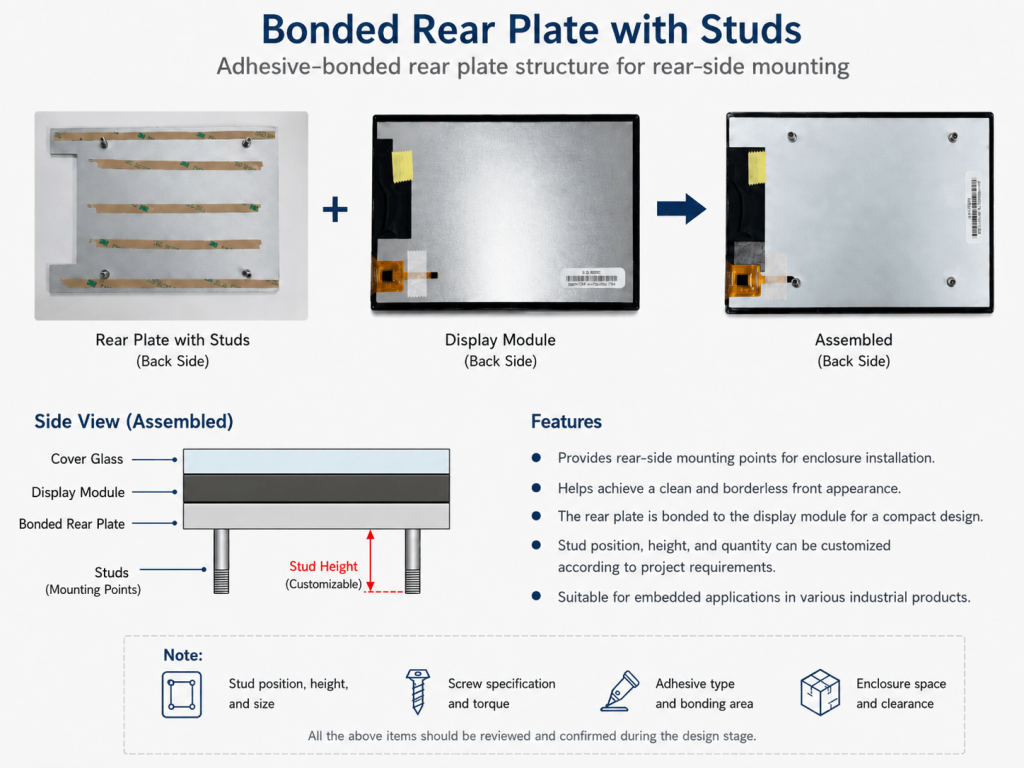
In this design, a rear mounting plate is bonded to the back side of the display assembly, and the studs provide fixing points for enclosure installation. The front cover glass and display area can be designed according to the final product appearance, helping reduce visible front-frame elements and support a cleaner, more borderless-looking design.
This structure is suitable for projects where the display needs to be mounted from the rear side, but the customer wants to maintain a simple and refined front appearance. Before sampling, engineers should review the rear plate size, stud position, screw direction, bonding area, cover glass outline, FPC clearance, and enclosure space.
Thread size, stud height, and stud position can be reviewed according to the customer’s housing design and assembly requirements.
For project teams developing a TFT display screen or touch screen LCD display for compact enclosures, this 7 inch IPS touch display with rear studs provides a practical example of easier mounting and better mechanical integration. The final structure depends on the housing drawing, screw direction, available space, and reliability requirements.
Project teams should confirm:
In some projects, rear stud locations may also support grounding or shielding design. The project team should confirm this based on the actual electrical and mechanical requirements instead of using a fixed assumption.
An LCD module with integrated rear studs is useful when:
For industrial, dashboard, medical, and embedded projects, rear studs can make the display easier to install and more stable after assembly.
At MAXEN, we support LCD display module development for different application requirements, including rear stud structure review, PCAP touch integration, cover glass design, OCR optical bonding, and high-brightness outdoor display solutions.
For LCD modules with rear studs, our engineering team can help review:
The goal is not simply to add studs to the back of a display. The goal is to make sure the final display module can be installed securely without affecting the backlight, LCD cell, FPC, touch sensor, or optical performance.
Early mechanical review can help reduce sample revisions, avoid enclosure mismatch, and improve the success rate of final product integration.
An LCD display module with integrated rear studs can help project teams simplify enclosure mounting, reduce loose hardware, improve alignment, and achieve more reliable mechanical integration.
Compared with traditional loose screws, washers, nuts, and brackets, integrated rear studs provide fixed mounting points directly on the display module. This can improve assembly efficiency, reduce installation risk, and support more compact enclosure design.
For industrial projects, two-wheeler dashboards, EV charging stations, medical terminals, and embedded devices, this structure can be a practical solution when display performance and mechanical installation both matter. If you are developing a display solution that requires rear studs, high brightness, custom cover glass, or OCR optical bonding, MAXEN can support early mechanical and optical review before sampling. Whether it is a compact touch display, an industrial TFT display screen, or a complete touch screen LCD display for outdoor equipment, early structure review can help reduce enclosure mismatch and improve final product integration.
If your team is designing a compact enclosure for an LCD display module, you can share your housing drawing, screw direction, stud position requirements, and cover glass design with MAXEN for early review.







+86-13923461826