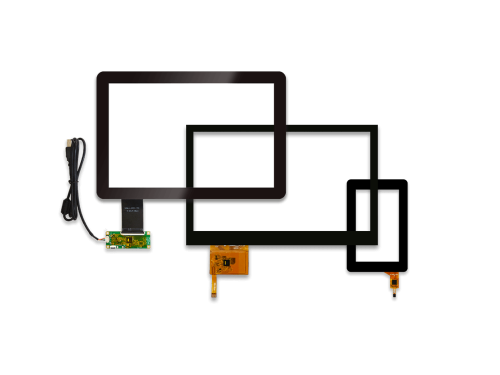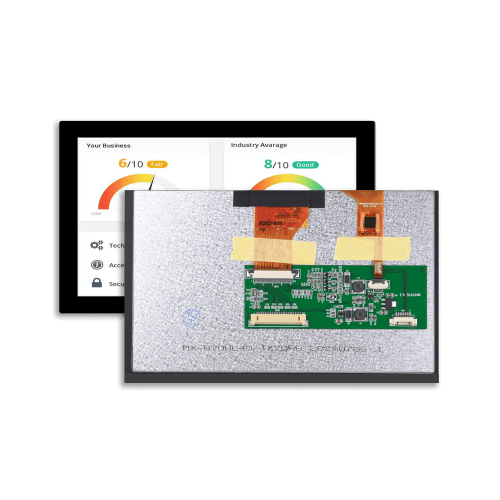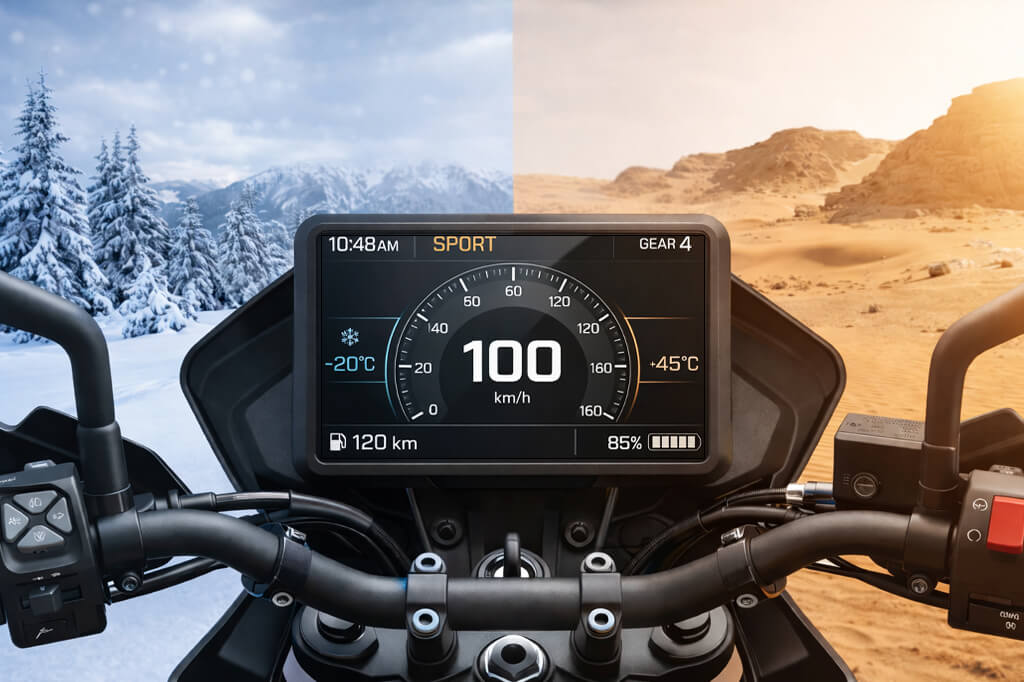
For reliability engineers and procurement directors sourcing instrument cluster display modules, display selection is not a routine purchasing decision. It is a critical engineering decision that must support stable operation in both Siberian winters and Middle Eastern summers.
Few electronic applications operate under harsher environmental conditions than a two-wheeler instrument cluster. Unlike consumer electronics used in relatively protected environments, these displays must withstand direct sunlight, heat rising from the engine, and overnight freezing conditions when the vehicle is parked and powered off.
Across the product lifecycle, a cluster display may be exposed to several extreme conditions:
Most consumer-grade displays are designed for an operating range of only 0°C to 50°C. That window is not sufficient for serious two-wheeler deployment. A professional wide-temperature TFT display for instrument cluster applications must be engineered and validated for a much broader -30°C to 85°C operating range.
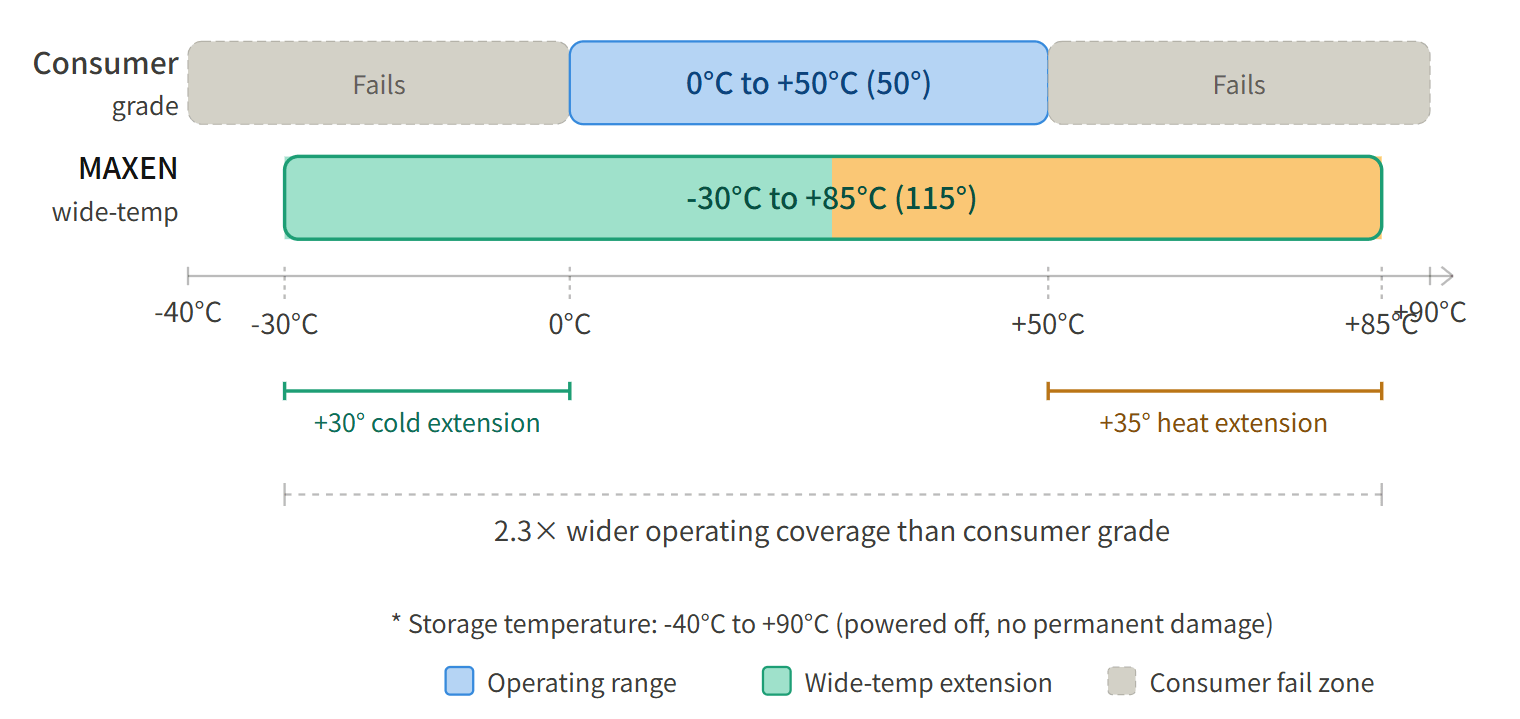
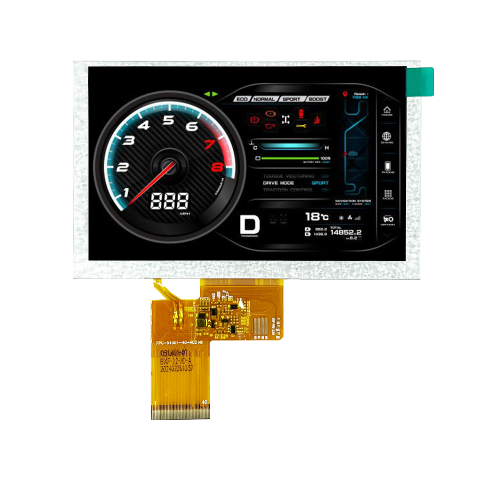
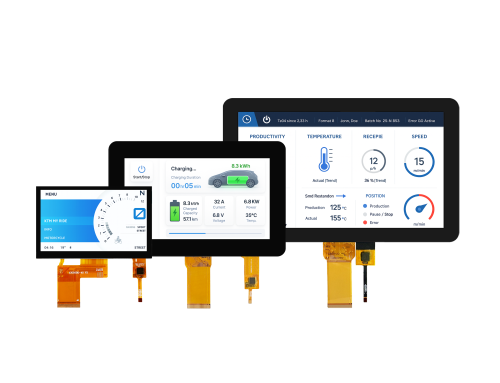
MAXEN’s Cluster Display LCD series is developed for exactly this type of application. Its automotive-grade products support features such as a 7-inch size, 1024×600 resolution, 1000 nits high brightness, an operating temperature range of -30°C to +85°C, and a storage temperature range of -40°C to +90°C, enabling OEMs to meet demanding climate conditions across global two-wheeler markets.
The main challenge in wide-temperature display design begins with the physical properties of the liquid crystal material itself. Liquid crystal exists in a state between solid and liquid, and its performance is highly temperature-dependent.
At low temperatures, viscosity increases and molecular reorientation slows down. As a result, response time becomes longer, which can lead to visible motion blur, ghosting, or afterimages during screen transitions. For riders, ghosting on a speedometer or turn signal is more than a visual issue. It can affect how quickly and accurately critical information is read while riding.
Under -30°C operating conditions, response time increases and background color shifts slightly. In a properly designed wide-temperature module, both effects are fully reversible. Once the display returns to normal temperature, optical performance recovers without permanent damage.
This is why wide-temperature liquid crystal selection matters. By using LC materials optimized for low-temperature viscosity behavior, engineers keep display performance within the specified range under cold-start conditions and avoid the black-screen failure or severe smearing often seen in consumer-grade panels exposed to low-temperature environments.range and avoid the black-screen failure or severe smearing often seen in consumer-grade panels used in cold climates.
The upper end of the temperature range introduces an equally critical set of failure modes for motorcycle screens exposed to equatorial sunlight over extended periods. We covered how high-brightness design keeps instrument cluster displays legible under direct sunlight in our earlier article, Why Sunlight-Readable TFT LCD Modules Matter for Two-Wheeler Instrument Clusters. This section focuses on a different dimension: the material damage that sustained high temperature alone inflicts on display module components.
When temperature rises beyond the phase-transition limit of a standard liquid crystal formulation, the LC When the operating temperature rises above the phase-transition limit of a standard liquid crystal formulation, the LC can enter an isotropic state and lose its ability to modulate light effectively. The result is a sharp reduction in contrast, or in extreme cases, a screen that becomes unreadable.
This is not a software issue or a temporary interface problem. It is a material limitation that can directly affect the rider's ability to read the instrument cluster.
MAXEN's automotive-grade wide-temperature modules are rated for operation up to +85°C. The LC formulation is selected so that the clearing point remains above the required working range, maintaining contrast stability and image integrity even in extremely hot outdoor conditions.
MAXEN applies strict UV durability requirements to cover glass material selection: all ink materials must pass a UV endurance test (wavelength 340 nm, irradiance 0.5 W/m²·nm, temperature 65°C, duration 600 hours), ensuring that the printed border area does not fade or yellow after prolonged sun exposure.
On the physical side, the cover glass uses Rainbow high-alumina silicate glass with a compressive strength (CS) of ≥ 650 MPa and surface hardness ≥ 7H, validated by a 110g steel ball drop test from 50cm height at the center point, three times without breaking — providing the impact resistance required for vibration-prone riding conditions. Between the touch module and the LCD panel, OCA or OCR full optical bonding eliminates the internal air gap, significantly reducing the risk of delamination caused by thermal expansion differentials at high temperatures.
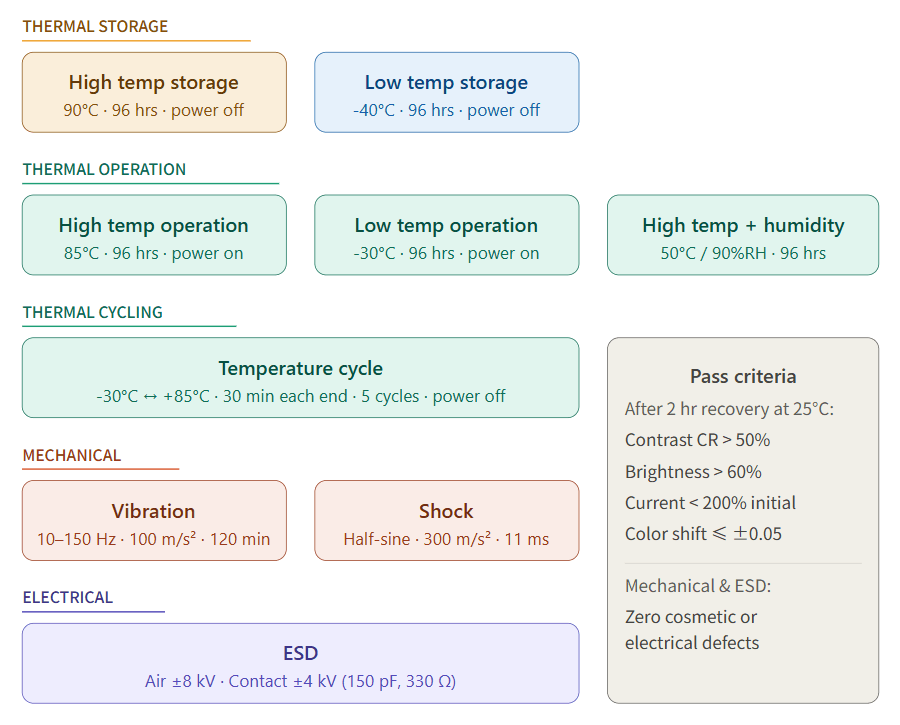
Selecting the right materials is the first step. Validating them through a structured test protocol is the commitment that responsible OEM procurement requires. Every MAXEN wide-temperature automotive-grade module must pass the following complete test suite before shipment — each item evaluated against quantitative pass/fail criteria, not visual inspection alone.
| Test Item | Test Condition | Power State |
|---|---|---|
| High Temperature Storage | 90°C, 96 hrs | Off |
| Low Temperature Storage | -40°C, 96 hrs | Off |
| High Temperature Operation | 85°C, 96 hrs | On |
| Low Temperature Operation | -30°C, 96 hrs | On |
| High Temp / High Humidity Operation | 50°C / 90% RH, 96 hrs | On |
After each test, the module is restored at 25°C for 2 hours, then evaluated against the following quantitative criteria: Contrast ratio CR > 50%, brightness retention > 60%, current consumption < 200% of initial value, color coordinate shift ≤ ±0.05.
-30°C ↔ +85°C cycling, with 30 minutes at each extreme and 5-minute transition intervals, for 5 complete cycles followed by a 2-hour recovery at 25°C. Appearance and electrical performance must show zero defects. This test replicates the real-world daily thermal cycle a motorcycle instrument cluster experiences — not a static soak at a single temperature extreme.
Vibration test: 10 Hz–150 Hz, 100 m/s², 120 minutes — simulating engine vibration and road surface irregularities. Shock test: half-sine wave, 300 m/s², 11 ms — simulating the mechanical impact of emergency braking or collision. Pass criterion: zero cosmetic or electrical defects permitted.
Air discharge ±8 kV, contact discharge ±4 kV (150 pF, 330 Ω) — ensuring the module withstands electrostatic events from rider contact or system power-on transients.
MAXEN wide-temperature automotive-grade modules carry a rated LED backlight lifetime of Min. 30,000 hours / Typ. 50,000 hours, driven at 60 mA with constant-current drive mode recommended for sustained brightness stability across the full service life.
At an average daily use of 4 hours, the 50,000-hour typical lifetime equates to over 34 years of operation — well beyond the design life of any two-wheeler platform. Even at the conservative minimum of 30,000 hours, the module outlasts 20 years of daily use. Backlight longevity is the primary determinant of overall module service life, and this quantified commitment is one of the first technical indicators procurement directors should verify when evaluating display suppliers.
When evaluating a supplier for two-wheeler instrument cluster applications, the following points serve as a practical baseline checklist.
Temperature Performance
Optical Stability
Reliability Testing
Backlight Lifetime
For two-wheeler OEMs competing on reliability in global markets, the instrument cluster display is a component that must never fail — not in a Siberian winter, not in a Middle Eastern summer, not after years of daily thermal cycling.
Wide-temperature LCD technology has evolved from a premium feature into a baseline requirement for any serious deployment. The engineering decisions that determine whether a module survives this environment — LC formulation, cover glass material specification, optical bonding process, test protocol rigor — are invisible on a size-and-price comparison sheet. They are embedded in a supplier's material engineering capability and quality system. MAXEN has spent 14 years building exactly that foundation, and every wide-temperature automotive-grade module we ship is backed by full technical documentation and test reports to support your team's engineering review and supplier qualification process.
Browse the full range of automotive-grade wide-temperature TFT LCD modules, including operating specifications, optical parameters, and reliability test summaries.
Browse MAXEN's Cluster Display LCD Series
Review existing models suitable for two-wheeler and electric vehicle instrument cluster applications.
Contact the MAXEN Engineering Team
Discuss a custom solution for your application, including size, brightness, touch integration, and interface adaptation. OEM and ODM support are available.


xiabenyue@outlook.com